App updates3 min read
How to Read Your BaZi Foundation Report in MingJing 1.5
MingJing 1.5 rewrites the Foundation report in seven sections: Day Master strength, pattern, climate, what helps and harms, combinations and clashes, and stars. Every conclusion shows the chart facts behind it.
You cast your BaZi chart, open the Foundation report, and the first thing you meet is a wall of terms: Day Master strength, pattern, climate, what helps and what harms. MingJing 1.5 rewrites the report into seven sections so the terms read in order: each section answers one question, and every conclusion shows the chart facts behind it.
The short version first: read the seven sections in this order — Day Master strength, pattern, climate, what helps and harms, pillar by pillar, combinations and clashes, and symbolic stars. Start with the first; it sets how the rest should be read. When a section puzzles you, look at the chart facts cited under it, not at memorised terms.
Which of the seven sections do I read first?
Section one is Day Master strength. The Day Master is the stem of your day pillar — it stands for you — judged on three things: season, roots, and supporting stems, with every root and visible stem listed as evidence. It doesn't just hand you "strong" or "weak"; it shows each step that produced the verdict.
Section two is pattern: following Zi Ping Zhen Quan, the pattern is taken from the month branch, with what forms, breaks and rescues it spelled out. Section three is climate: all 120 entries of Qiong Tong Bao Jian, the original text beside a plain reading. Section four, what helps and harms, puts the first three conclusions side by side, agreements and disagreements both stated. The last three go pillar by pillar: each pillar in turn, then combinations and clashes, then symbolic stars, each marked with its pillar.
What do I see when I tap a luck cycle?
In 1.5, luck cycles and years can be tapped open: tap any cycle or year for a reading written for your chart — what Ten God it brings, whether it lands on what helps or harms you, and how it combines or clashes with your natal chart.
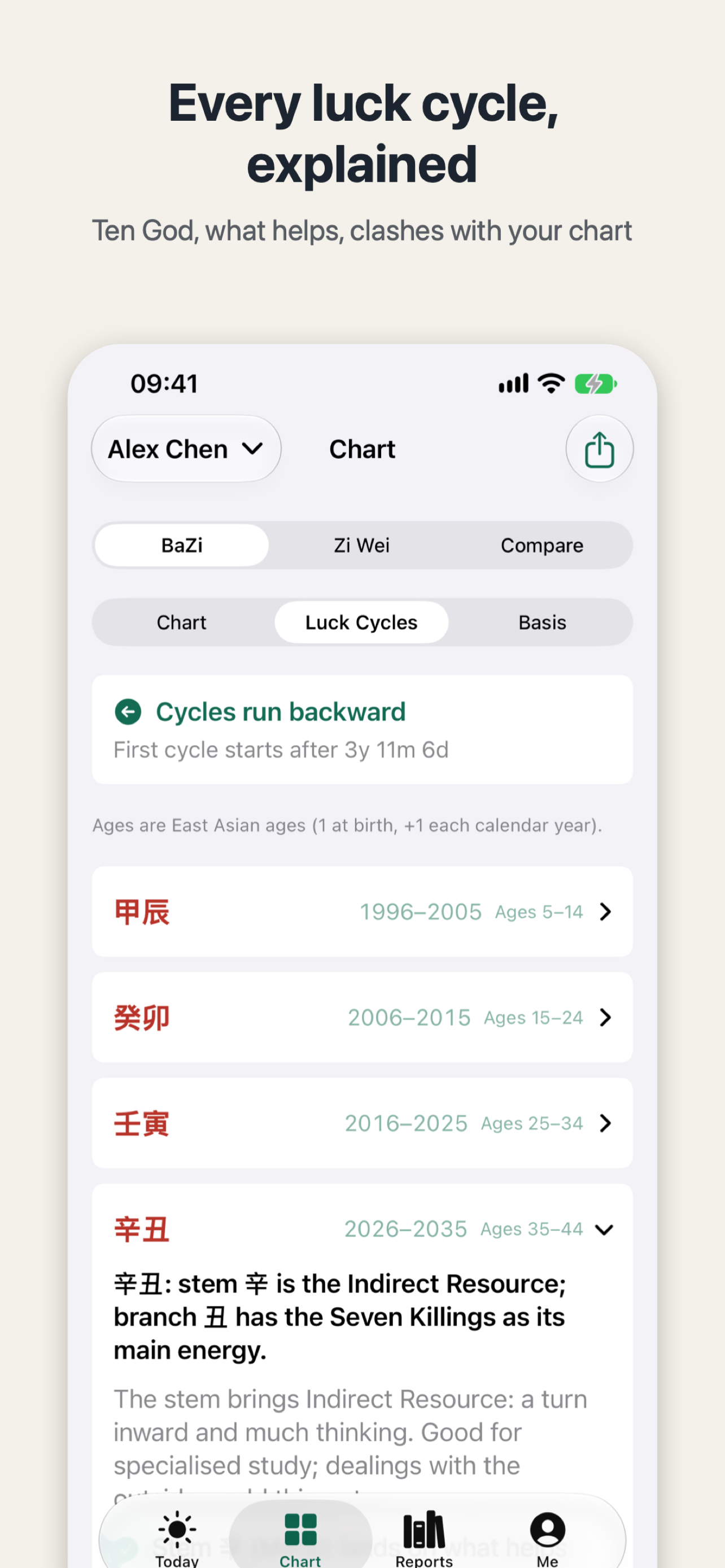
Below, one cycle tapped open: cycles run backward here, the first starting after 3 years, 11 months and 6 days; the Xin Chou cycle now running is 2026–2035, ages 35–44. It reads "stem Xin is the Indirect Resource; branch Chou has the Seven Killings as its main energy" — a turn inward and much thinking — and the checked lines say the stem Xin lands on what helps.
Before you save a new profile, check whether the hour pillar changes
Another 1.5 change hides in the new-profile flow: once you pick a birth city, MingJing shows clock time and true solar time side by side, so you can see whether the hour pillar changes before you commit. Existing profiles are untouched.
Worth a second look: a different hour pillar changes the Ten Gods and what helps and harms across the whole chart. MingJing carries 418 cities; pick one and the time zone and longitude fill in for you.
Two things added to the chart page
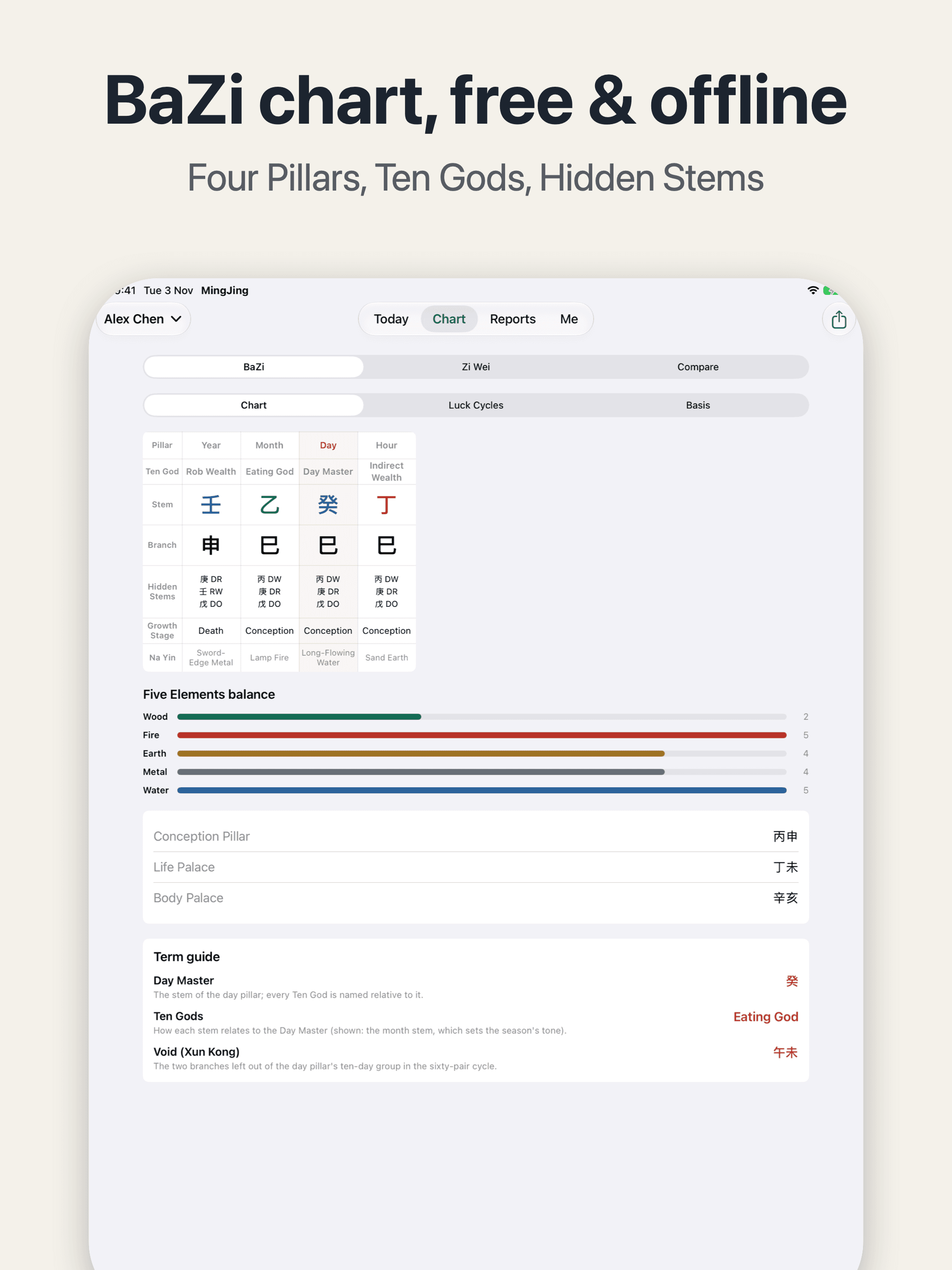
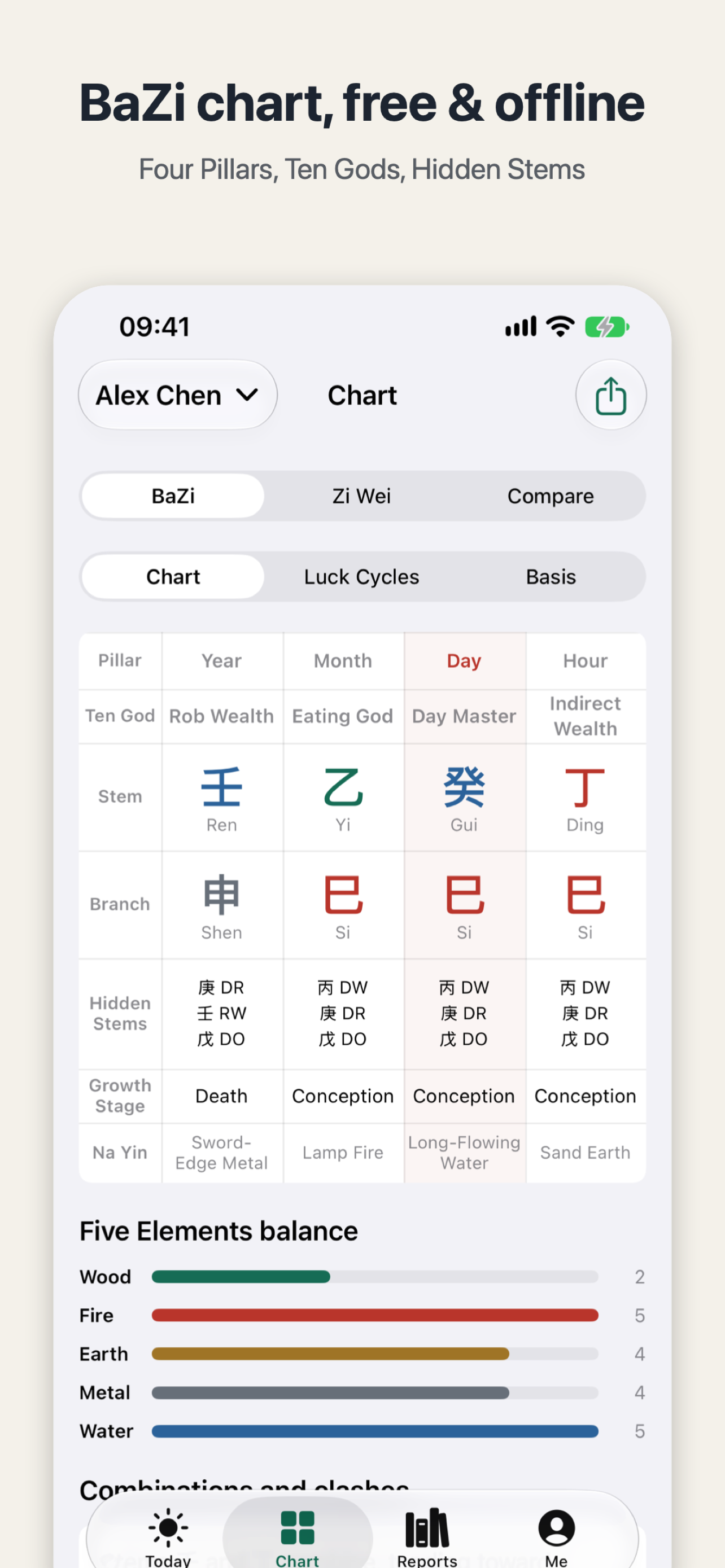
Back on the chart page, 1.5 adds combinations, clashes and stars below the table, and colours the branches by element. The chart below is the sample profile Alex Chen: pillars Ren Shen, Yi Si, Gui Si, Ding Si, Day Master Gui; Five Elements balance Wood 2, Fire 5, Earth 4, Metal 4, Water 5. The colours show at a glance which pillars relate to each other, instead of checking a branch table yourself.
Two smaller changes: the Annual, Career, Relationship and Growth reports go deeper too, and English now shows the reading of each stem and branch and spells out the four transformations in full. Version 1.5 shipped on 21 November (22 November New Zealand time), free, with no in-app purchases or ads.
New to MingJing? Read MingJing 1.4: How to Read Your First BaZi Chart first — it walks through creating a profile from scratch and reading your first chart.
Next step: update MingJing to 1.5, open your own Foundation report, read the first section on Day Master strength, then tap the luck cycle you are in now and see whether its Ten God lands on what helps or harms you. MingJing presents structure and tendencies from traditional culture; it doesn't decide anything for you.

MingJing
A free, offline BaZi chart and report app that shows how every result was calculated.

 Scan with your iPhone