Guides3 min read
How to Cast an I Ching Hexagram with Three Coins
To cast an I Ching hexagram with three coins, write your question in MingJing and tap Cast six lines: six lines appear as one hexagram, with a plain-language reading and a changing hexagram to think with.
You have a question you cannot settle — should you change your work focus this month? Asking around pulls you in different directions, and thinking in circles gets nowhere. To cast an I Ching hexagram with three coins, you need no coins and no reference book: just the question written down, and six lines cast on your phone.
In MingJing, casting takes three steps: write the question as one sentence, tap Cast six lines, and read the result. All 64 hexagrams are in the app, and whichever one comes up arrives with a plain-language reading and its changing hexagram beside it.
How do I phrase the question before casting?
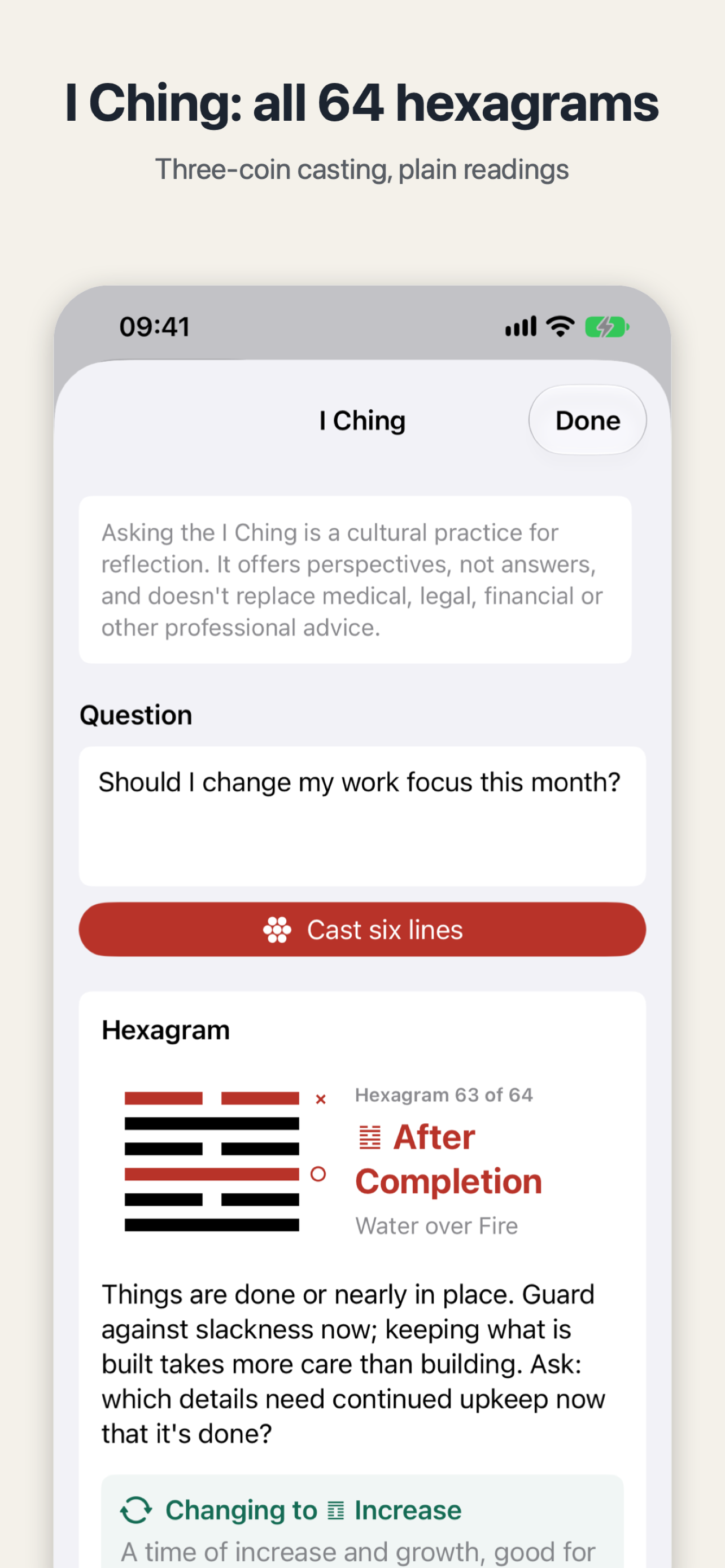
Open I Ching and the first thing you see is a note: asking the I Ching is a cultural practice for reflection. It offers perspectives, not answers, and does not replace medical, legal, financial or other professional advice. Below the note is the Question field, and one sentence is enough.
The more specific the question, the more the reading has to work with. The example in the screenshot is a good one: "Should I change my work focus this month?" It has a time frame (this month) and an action (changing focus), so each line of the reading can be held against your actual situation. Ask only "how is work going" and even the plainest reading has nothing to land on.
When the sentence is written, tap the red Cast six lines button, and all six lines are cast at once.
How do I read the six lines I just cast?
The six lines stack into a hexagram, with its picture, name and number in one place. Say you cast Hexagram 63, After Completion, Water over Fire: two of its six lines are shown in red, marked with × and ○. Those are the moving lines, the lines in the middle of changing.
Read the plain-language text first. For After Completion it says: "Things are done or nearly in place. Guard against slackness now; keeping what is built takes more care than building." The reading closes with a question of its own: "which details need continued upkeep now that it's done?" That question is the part the reading really wants you to take away — it turns the hexagram from a description of where you stand into a decision about what you do next.
What is the changing hexagram for?
The changing hexagram is not a second answer. It is the same hexagram with its moving lines flipped over, and it works as a reference for the direction things may develop.
After Completion changes into Increase: a time of increase and growth, good for action, learning and helping others, with the old advice to learn from what is good and correct what is wrong — and its own question, "what do I most want to increase right now?" Read the first hexagram for where things stand, and the changing one for where they may be heading. Together, the two are one complete casting.
What casting cannot do for you
MingJing presents traditional structure for cultural interest and self-reflection. It describes tendencies and does not make decisions for you, and it is not a substitute for medical, legal, financial or other professional advice. A casting will not tell you what you should or should not do. It restates what you already know in different words, then pushes you one step further, so that the decision stays yours.
Casting is only one of the tools in MingJing. If you want the chart side of the app as well, the guide to reading the twelve Zi Wei palaces from one birth profile shows how one profile gives both a BaZi and a Zi Wei chart. Charts and casting are two different tools — do not mix them up.
Next time a question keeps circling in your head, open MingJing, write it down in one sentence, cast six lines, and start with the question the reading leaves you.

MingJing
A free, offline BaZi chart and report app that shows how every result was calculated.

 Scan with your iPhone