App updates3 min read
How to Read a Zi Wei Dou Shu Chart on Your iPhone
To read your Zi Wei Dou Shu chart, you do not need a second app: MingJing 1.3 turns one birth profile into a twelve-palace Zi Wei chart, with stars, transformations and pattern cards on one board.
You already have a BaZi chart, but your friends are talking about Zi Wei Dou Shu, and you cannot follow them. They mention the Spouse palace and the Life palace, while you are holding four pillars. The two charts have simply lived apart, with your birth time entered twice and not always under the same time rules.
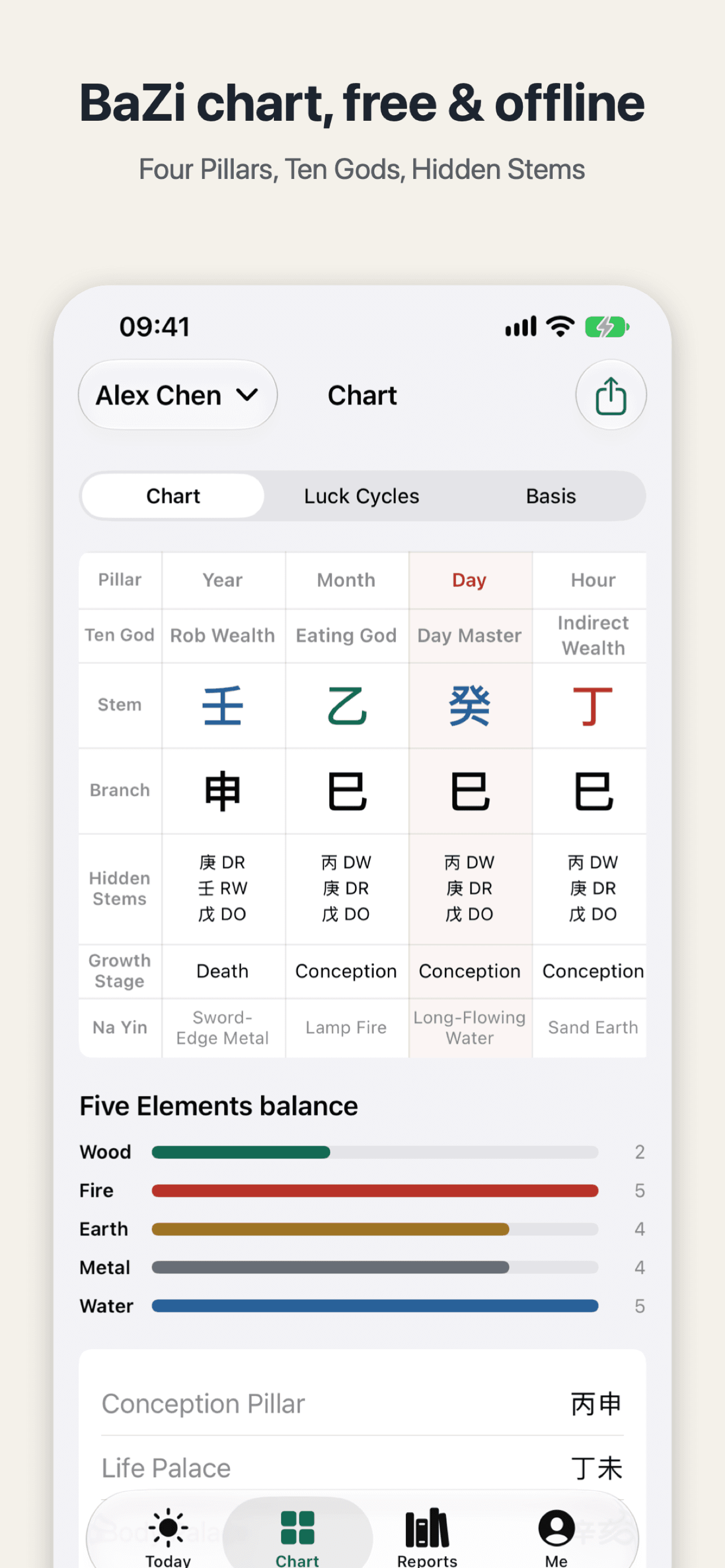
MingJing 1.3 answers that directly. The Chart tab now offers BaZi, Zi Wei and Compare, and one birth profile gives both charts, with the same birth instant, true solar time and late Zi rule as BaZi.
How do I read the twelve palaces of a Zi Wei Dou Shu chart?
Start with the board itself. A Zi Wei chart is a square board of twelve palaces, with the Life palace as the starting point. In MingJing 1.3, the Natal, Decade, Year and Month layers stack on one board, with a year slider to move between years.
Long-press any palace to read it as the Life palace. That reorders the palace names around it, so reading the Spouse palace as the Life palace shows the chart from a partner's side. Learn the positions first, then look inside each palace: major, auspicious, malefic and minor stars, in seven brightness levels. Brightness says how strong a star is in that palace; the birth-year transformations say which way it moves. Palace details also show the four directions, flanking palaces, and borrowed stars for empty palaces.
How does BaZi compare with Zi Wei on the same chart?
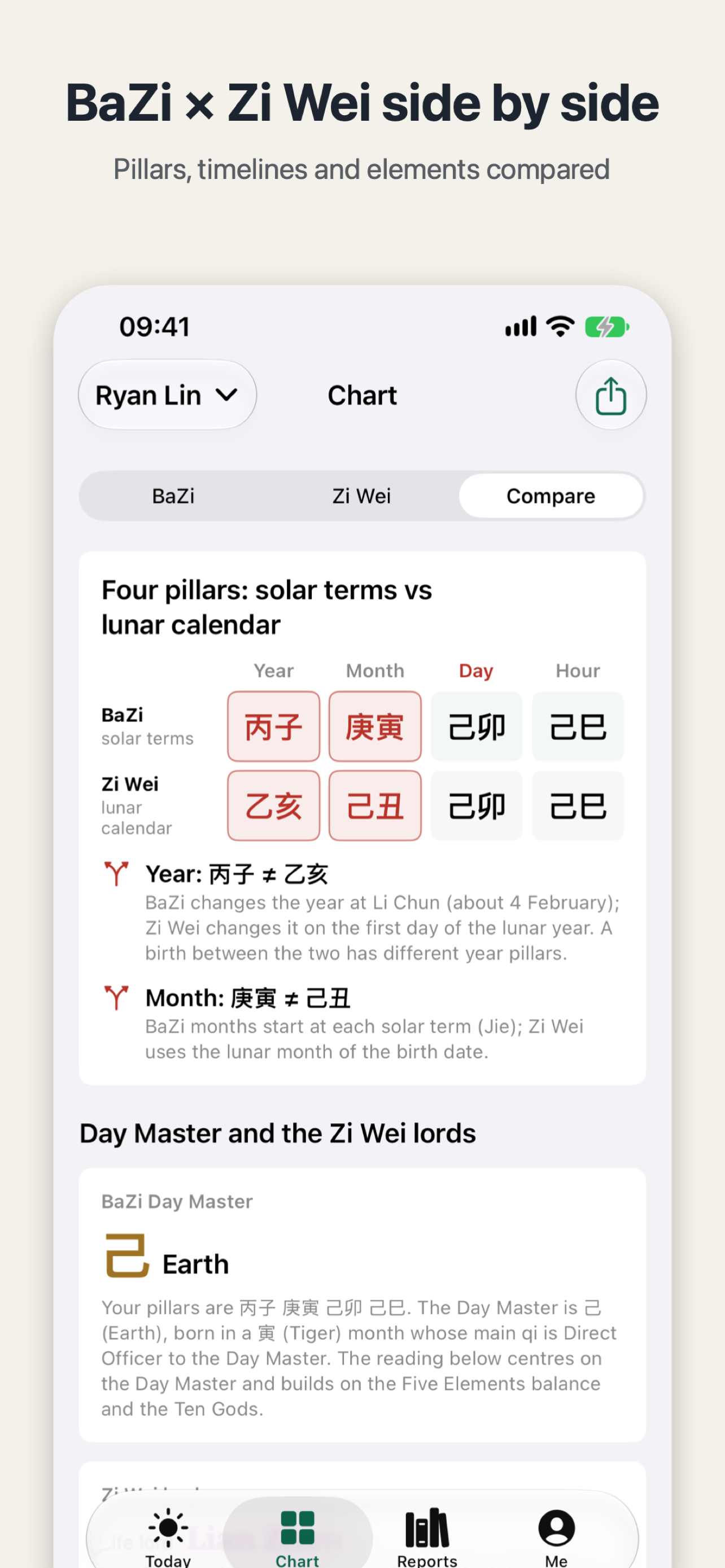
That is what the Compare view is for. Solar-term pillars sit next to lunar pillars, with any difference highlighted and explained. Luck cycles and decades share one timeline, the Day Master sits next to the Life and Body lords, and the element balance sits next to the five-element class.
Comparing is not about collecting a second opinion. It stops you converting between two systems by hand: with luck cycles and decades on one timeline, they are two ways of talking about the same stretch of time.
If you were born outside China, one earlier fix matters here too. MingJing 1.1 corrected the solar-term boundary for overseas births, so terms switch at the same instant as in Beijing; the MingJing 1.1 fix for overseas solar-term boundaries explains that change, and 1.3 uses the same rules.
How do I read the stars and pattern cards in a palace?
Do not start with the star names. Open a palace and look at its pattern card first. It lists required, bonus and breaking conditions in three layers, with the classical source attached, so you do not have to guess from memory.
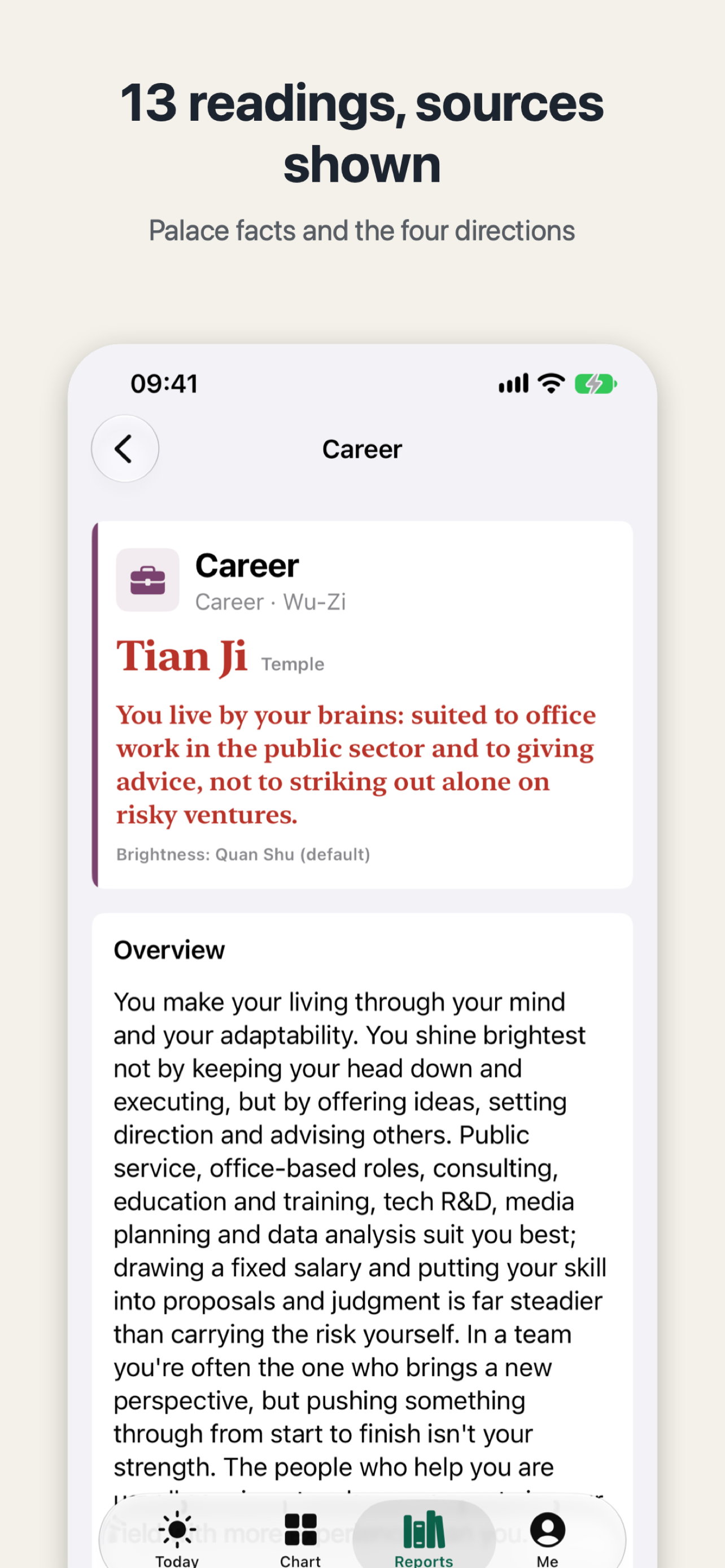
Then read the thirteen Zi Wei readings: overview, personality, relationships, career, money, health and more. Every line carries its source, and all thirteen can be exported as one PDF, so you can check one reading against another instead of starting over.
When should I use compatibility, and when should I ask my chart?
Compatibility puts two profiles side by side: spouse palaces, transformations into each other's chart, branch relations, and decades in step for thirty years. It lists structure only, gives no score, and leaves out birth data by default. Asking your chart is different: on devices that support Apple Intelligence, you can ask a question and get an on-device answer, with every point citing the palaces, stars and patterns it rests on.
MingJing presents traditional structure for cultural interest and self-reflection. It describes tendencies and does not make decisions for you, and it is not a substitute for medical, legal, financial or other professional advice. For everyday use, the Today tab and widgets show today's pillars and the Zi Wei daily Life palace.
Next time you open MingJing, do not stop at the BaZi page. Switch to Zi Wei, drag the year slider, then long-press the palace you care about most.

MingJing
A free, offline BaZi chart and report app that shows how every result was calculated.

 Scan with your iPhone